Photo Booth Space and Setup Requirements: Everything Your Venue Needs to Know
Quick Answer
Most photo booths require a 10×10 ft footprint, a standard 110V outlet within 25 ft, and a flat hard surface for setup. AI and glam booths may need up to 10×12 ft. Vendors typically arrive 90 minutes to 2 hours before the event starts for load-in and testing.
One of the first questions venue coordinators and event planners ask us is: "How much space does the photo booth need?" It's an important question, get it wrong and you end up with a cramped booth in a corner where nobody finds it, or a setup that blocks traffic flow and creates a bottleneck.
After setting up at 500+ events across Los Angeles, from wedding, receptions to rooftop corporate parties to backyard quinceañeras, I know the exact space requirements for every booth type. I'm Liz Colon, founder of Captured Celebrations, and this guide gives you everything you need to plan your booth placement and coordinate with your venue.
Space Requirements by Booth Type
Every photo booth type has different footprint needs. These numbers include the booth itself, the backdrop, lighting, and enough room for guests to pose comfortably.
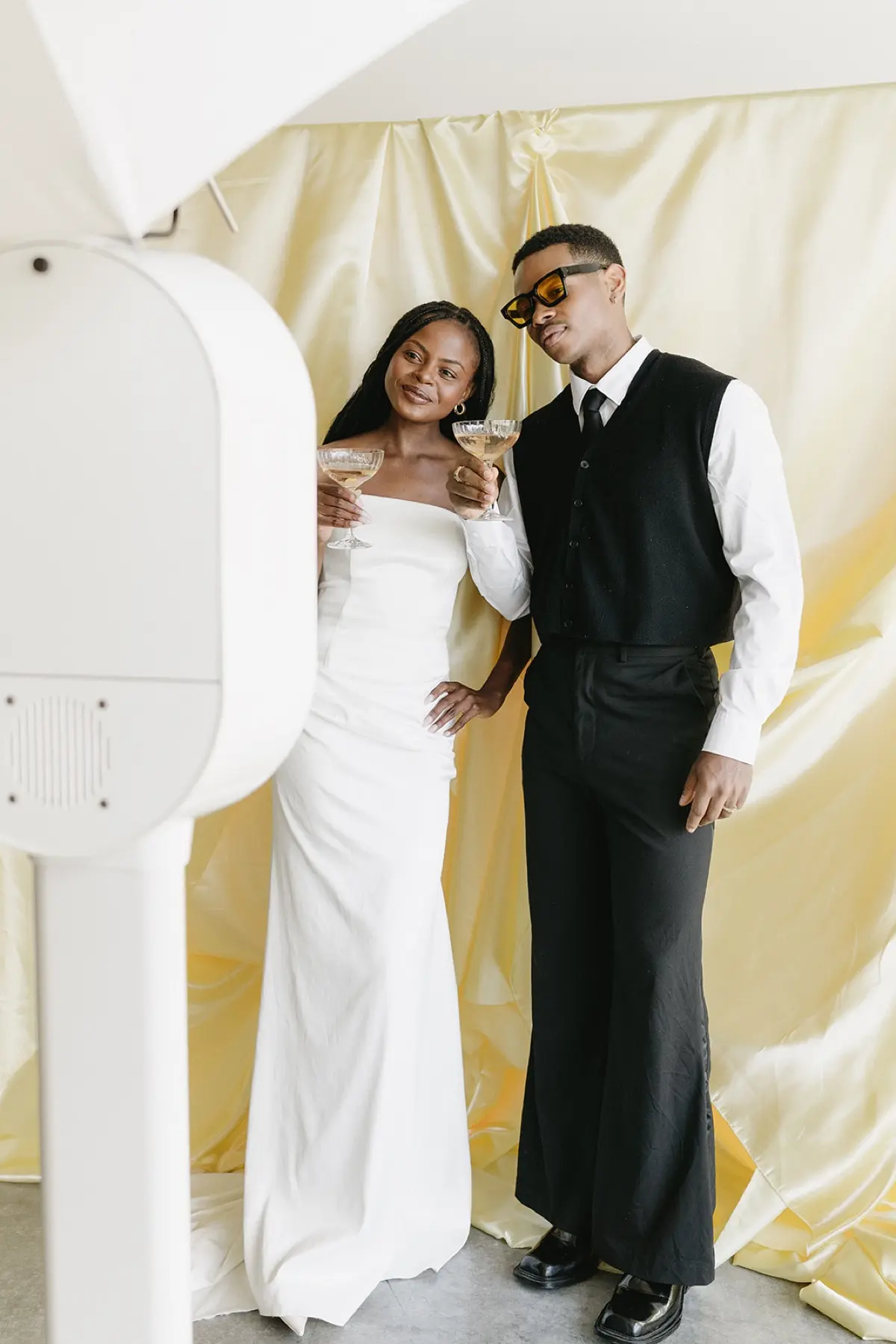
Open Air Photo Booth: 10x10 Feet
The open air photo booth is the most compact option and the easiest to fit into tight venue layouts.
| Component | Space Needed |
|---|---|
| Camera + stand | 3x3 ft |
| Backdrop + frame | 8 ft wide x 8 ft tall |
| Guest posing area | 6x4 ft (in front of backdrop) |
| Lighting stands | 2 ft on each side |
| Total footprint | 10x10 ft minimum |
The open air booth works in virtually any venue because it has no walls or enclosure. It fits on patios, in corners of ballrooms, under tents, and in restaurant private dining rooms. For very tight spaces (like restaurant corners), we can reduce the footprint to about 8x8 feet by using a narrower backdrop and adjusting the lighting placement.
Oak Photo Booth: 12x12 Feet
The Oak Photo Booth is a solid oak frame on a wooden tripod with a 19-inch vertical touchscreen. It requires a bit more room because guests stand close to the screen and need space to step back for group shots.
| Component | Space Needed |
|---|---|
| Oak booth and tripod | 2x3 ft |
| Backdrop behind the booth | 8 ft wide x 8 ft tall |
| Guest interaction area | 6x6 ft (in front of the booth) |
| Lighting | 2 ft on each side |
| Total footprint | 12x12 ft minimum |
The Oak Booth works best against a wall or in a defined area so the camera angle stays consistent. We typically set it up against a flat wall with the backdrop framing the booth. At about 32 lbs it sets up in roughly a minute.
Glam Photo Booth: 10x10 Feet
The glam booth creates portrait-quality photos and uses a focused lighting setup. It needs about the same space as an open air booth.
| Component | Space Needed |
|---|---|
| Camera + stand | 3x3 ft |
| Beauty dish / key light | 3 ft overhead clearance |
| Backdrop | 6 ft wide x 8 ft tall |
| Guest posing area | 4x4 ft |
| Total footprint | 10x10 ft |
One key requirement: the glam booth needs at least 8.5 feet of ceiling height for the overhead beauty dish light. Most standard venues have this, but some tented events or low-ceiling spaces might not. Always confirm ceiling height with your venue.
360 Video Booth: 12x12 Feet
The 360 booth requires the most space because a camera rotates around the guest on a motorized arm. The entire rotation path needs to be clear.
| Component | Space Needed |
|---|---|
| Platform (center) | 4 ft diameter |
| Camera arm rotation | 6 ft radius |
| Safety clearance | included within the 6 ft rotation radius |
| Total footprint | 12x12 ft minimum |
The 360 booth also needs a flat, level surface. It cannot be set up on grass, gravel, or uneven ground. The rotating arm requires precision. Indoor venues with hard floors are ideal. If your event is outdoors, a flat patio, deck, or plywood platform over grass works.
Enclosed Photo Booth: 10x12 Feet
The enclosed booth is a classic curtained or walled structure that provides privacy for guests.
| Component | Space Needed |
|---|---|
| Booth structure | 5x5 ft |
| Entry/exit path | 3 ft on one side |
| Queue space | 4x4 ft in front |
| Total footprint | 10x12 ft |
Enclosed booths need to be positioned where guests can walk around them freely. Placing one in a tight corner with only one side accessible creates a traffic jam.
Studio Quality Booth: 10x10 Feet
The studio booth uses a similar footprint to the open air booth but with additional professional lighting stands.
| Component | Space Needed |
|---|---|
| Camera + stand | 3x3 ft |
| Studio lighting (2-3 stands) | 3 ft on each side |
| Backdrop | 8 ft wide x 8 ft tall |
| Guest posing area | 5x4 ft |
| Total footprint | 10x10 ft |
Power Requirements
Every photo booth needs electricity. Here's what each setup draws and what your venue needs to provide.
Standard Power Needs
| Booth Type | Power Draw | What's Needed |
|---|---|---|
| Open Air | ~500W | One standard 15A outlet |
| Glam Booth | ~600W | One standard 15A outlet |
| Oak Photo Booth | ~500W | One standard 15A outlet |
| Studio Quality | ~700W | One standard 15A outlet |
| 360 Video | ~800W | One dedicated 15A outlet |
| Enclosed Booth | ~600W | One standard 15A outlet |
| AI Photo Booth | ~800W | One standard 15A outlet + strong WiFi |
A single standard 15A household outlet (the kind you plug a lamp into) handles most booth setups. The key is that we need a dedicated circuit, meaning no other high-draw equipment (DJ speakers, catering warmers, string lights) should share the same breaker.
Extension Cord Policy
We carry professional-grade extension cords rated for our equipment. We can run power up to 100 feet from the nearest outlet. However, shorter runs are better, electrical resistance over long cord runs can reduce power delivery.
Outdoor Events Without Outlets
For outdoor venues without accessible power, options include:
- Generator. We can use a quiet inverter generator (Honda EU2200i or similar). These run at conversation-level volume and provide clean power.
- Venue generator hookup, Some outdoor venues have generator hookups or temporary power panels. Ask your venue coordinator.
- Battery-powered options, Some digital-only setups can run on battery for 3-4 hours, but this limits functionality (no printer, reduced lighting).
WiFi Requirements
Most booth types work without internet, photos are stored locally and delivered via a digital gallery after the event. However, two setups need strong WiFi:
- AI Photo Booth, AI transformations require real-time cloud processing. We need a minimum of 10 Mbps upload speed.
- Social media sharing station: If guests want to text/email photos to themselves during the event, we need WiFi or cellular signal.
Load-In Timing and Setup
How early we need to arrive and how long setup takes varies by booth type and venue complexity.
Standard Setup Times
| Booth Type | Setup Time | Recommended Arrival |
|---|---|---|
| Open Air | 30-45 min | 1.5 hours before event |
| Glam Booth | 30-45 min | 1.5 hours before event |
| Oak Photo Booth | 45-60 min | 2 hours before event |
| Studio Quality | 45-60 min | 2 hours before event |
| 360 Video | 90 minutes to 2 hours | 2.5 hours before event |
| Enclosed Booth | 90 minutes to 2 hours | 2.5 hours before event |
We arrive early enough to set up, test everything, calibrate lighting for the specific venue conditions, and be fully operational before the first guest walks in. We never set up "during" the event.
Venue Coordination
Here's what we need from your venue coordinator before event day:
- Loading dock or entrance location, Where do we bring equipment in? Some venues have dedicated vendor entrances.
- Elevator access (if applicable), Our equipment cases don't fit in standard elevators at some venues. We need freight elevator access or ground-floor setup.
- Exact booth placement, Show us on a floor plan or walk us through the space. We want the booth visible and accessible but not blocking traffic.
- Power outlet location, Where's the nearest outlet to the planned booth spot? We need to know before arrival.
- Setup window, When can we load in? Some venues restrict vendor access until a certain time.
- Surface type: Indoor hard floor, outdoor concrete, grass, sand? This affects stability and setup approach.
Tear-Down and Load-Out
Tear-down is faster than setup, typically 20-30 minutes for any booth type. We start packing up as soon as the contracted time ends (or when the host gives us the go-ahead if the event is winding down early).
We leave the space exactly as we found it. All cables, tape marks, and equipment are removed. If we placed protective pads under equipment stands (which we do on hardwood floors), those come with us too.
Late-Night Events
For events that run past midnight, we plan our load-out to be as quiet as possible. No loud case rolling, minimal lighting, and quick efficiency. If the venue has noise restrictions after a certain hour, let us know in advance.
Common Venue Challenges and Solutions
After 500+ events, we've seen just about every venue curveball. Here are the most common issues and how we handle them.
Low ceilings (under 8 feet). We switch to compact lighting setups and skip the overhead beauty dish. Photo quality stays high with adjusted side lighting.
No flat wall for backdrop. We use freestanding backdrop frames with weighted bases. No wall attachment needed.
Grass or uneven ground. We bring leveling boards and sandbag weights. The open air booth works great on grass. The 360 booth does not. It needs a flat platform.
Narrow doorways, Our equipment breaks down into cases that fit through standard 30-inch doorways. For very tight spaces (some historic venues), we disassemble further and reassemble on-site.
Multiple floors with no freight elevator. We can carry equipment upstairs. It takes longer, so we add 30 minutes to our arrival time. Just let us know in advance.
Planning Your Booth Placement
The best spot for a photo booth balances visibility, accessibility, and flow.
Do
- Place the booth near the dance floor or bar, high-traffic areas where guests naturally congregate
- Position it so the backdrop faces away from windows (avoids backlighting issues)
- Leave 4-6 feet of clear space in front of the booth for a queue line
- Make sure there's a path to the booth that doesn't cross the dance floor or food service area
Don't
- Hide the booth in a separate room or behind a partition, guests won't find it
- Place it directly next to the DJ/band. The noise makes conversation with the attendant difficult
- Block fire exits, emergency paths, or venue doors with booth equipment
- Set up on thick carpet (it makes the backdrop frame unstable without additional anchoring)
Ready to Plan Your Setup?
If you're working with a venue coordinator and need exact specifications for your event, we're happy to provide a detailed setup plan. Check out how our process works. We handle all venue coordination as part of our standard service.
Browse our full booth lineup to see which type fits your space:
- Open Air Photo Booth, 10x10 ft, most versatile
- Enclosed Photo Booth, 10x12 ft, classic privacy
- Oak Photo Booth, 12x12 ft, interactive experience
- 360 Video Booth, 12x12 ft, maximum wow factor
We also work with your other vendors to coordinate load-in schedules. If your florist, DJ, and caterer all need the same loading dock at the same time, we'll work out a timing plan so everyone gets in and set up without conflict.
Call us at 747-895-4473 or request a quote. When you reach out, mention your venue name and we'll let you know if we've set up there before. There's a good chance we have, and we can share specific tips for that space.
Explore Our Services
Ready to Book a Photo Booth in LA?
Award-winning photo booths for every celebration. Serving all of Los Angeles County.